


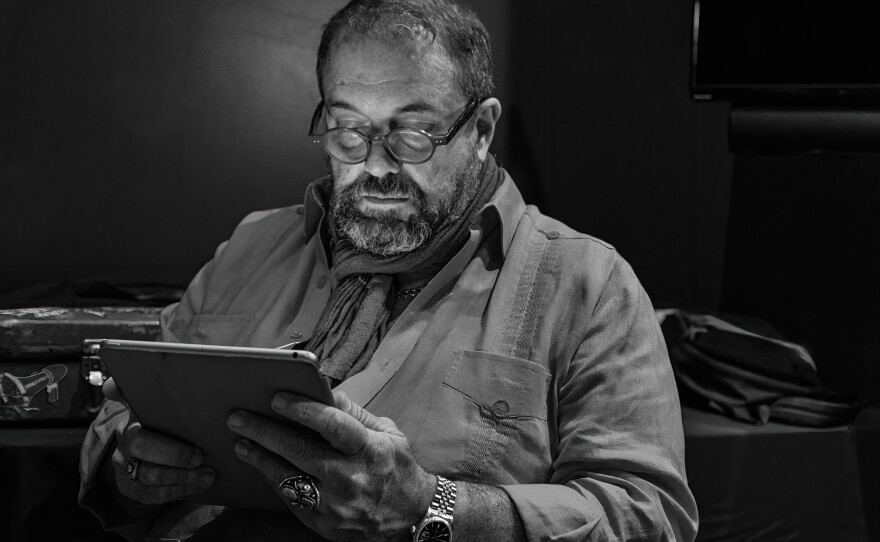
Following a bittersweet two-night celebration of his life at the historic Ryman Auditorium, and after an exhausting and painful battle with a devastating form of cancer, beloved Nashville singer and songwriter Raul Malo died at home on Monday night, surrounded by his family and friends. Malo’s magisterial tenor voice and his deft blending of classic roots and pop genres with Latin traditions, propelled The Mavericks, a truly radical band in the history of country music, to the top ten in the 1990s and to a foundational role in the story of Americana music.
Malo, felled by disease at only 60 years old, was a dashing life-force of a man, a bon vivant and a radiant soul who uplifted and supported artists across several musical communities. Son of migrants from Castro’s Cuba, Malo lived his heritage with pride, culminating in a 2017 PBS special that documented his first adult travels there, as well as a concert in a place he called “the roots of my musical soul” and “the home I’ve never known.” Through the Mavericks and a string of solo albums and side projects, Malo shared the luxurious sounds of Spanish lyrics, seductive Latin poly-rhythms, and the textures of instruments like requinto, bajo sexto and accordion.
The weekend unfolded like some implausible movie script. A two-night run at the Ryman Auditorium, booked many months ago as another in a traditional December Mavericks home stand, was re-imagined in recent weeks as a celebration of Raul Malo’s life and music. For a time, the band hoped he would be there as a guest of honor, even as it became more clear that his condition was terminal. On the night before the first concert on Dec. 5, he was taken to the hospital, where he was able to take in a live stream of the shows. He was moved home during the weekend where he spent his final days of life, at times literally serenaded by close friends.
“At 8:52 pm on December 8th, 2025, my love… our boys’ father… a devoted son and brother… and a friend to so many, gained his angel wings. He was called to do another gig — this time in the sky — and he’s flying high like an eagle,” his wife Betty wrote online on Tuesday morning. His sons are Dino, Victor, and Max. “No one embodied life and love, joy and passion, family, friends, music, and adventure the way our beloved Raul did. Now he will look down on us with all that heaven will allow, lighting the way and reminding us to savor every moment.”
Friends from across the music world shared tributes. “Raul had an uncanny ability to make men and women swoon - of all ages and generations. It was extraordinary how he would make men cry,” says WMOT’s own Shilah Morrow, a decades-long friend of Malo’s and co-manager of the Mavericks between 2015 and 2018. “He was one of the most passionate artists about life, about being a father, a lover, a husband. He could tap into every one of our human emotions - male, female, young, old, shake your ass, make out, cry. He was able to hit all of those human experiences with incredible passion. And that was extraordinary.”
By phone on Tuesday morning, Morrow emphasized that the Mavericks possess an ultra-rare combination of qualities: top-tier musicianship across the board, from rhythm section to horns, as well as being as flat-out entertaining and danceable as any live act of their time. “Most of the time those two don’t connect,” she noted. And as for Raul, he was a deeper musician than many understood. “He was an exceptional guitar player,” Morrow said. “Most people can’t get past the magnificence of his voice. But it didn’t just come from his throat and his words. He was a bass player in his first band and a background singer. He would turn in demos on his iPhone using Garage Band. And we used to have to go in and (try to) beat these demos, and he had played every part!”
Another old friend and colleague, artist and studio manager Sharon Corbitt, said, "The Mavericks are such a part of the fabric of what makes American music so incredible. I was sitting at the show on Saturday night, and I didn’t expect it to hit me so hard, but it did. I was thinking that if the rest of the world could be sitting in the room with all of us, all the crazy divisiveness we’re dealing with in the world would not be going on. At a Mavericks show you are never thinking about the next song or the next act. It forced you to be present and wrap yourself up in the joy and musical celebration.”
The Mavericks, even with two stretches of time apart, released a total of 13 studio albums. Early in their career, they won three ACM and two CMA Awards for their vocals, plus a Vocal Performance Grammy Award in 1996 for “Here Comes The Rain,” among many more nominations. 1998’s single “Dance The Night Away” proved the global appeal of the band by charting as a Top 5 pop hit in the UK. In 2021, the band accepted the Americana Trailblazer Award for “fusing country music with claves and string-band textures from Malo’s family heritage in Cuba.” Malo took on nine solo albums that let him develop ideas that didn’t fit neatly in the Mavericks’ repertoire. He also contributed to the Latin supergroup Los Super Seven in the early 2000s and sang the title track on the Grammy-winning tribute album Beautiful Dreamer: The Songs of Stephen Foster.
At the Ryman, it was announced that Malo had been selected for the National Music Council’s prestigious American Eagle Award for 2026. The 85-year-old institution presents the award for “distinguished service to American music.” It has gone in the past to Dizzy Gillespie, Odetta, Richie Havens, Quincy Jones, Stephen Sondheim, and many other luminaries. Scheduled for January, the award’s unveiling was accelerated to be part of Malo’s show, and its announcement cited “a catalog defined by bold experimentation and timeless songwriting.”
In a letter to fans that was read during Friday’s show, Malo said: “I've always believed that music is one of the most powerful bridges we have. It crosses cultures, politics, (and God, don't we need that right now?) languages, and sometimes pain. In these past months, I've had to fight battles I've never imagined. But on the hardest of days, music remained my companion. Your letters, your stories of how a song helped you through loss, heartbreak, joy, those became our songs. You all carried me more than you know.”
Raul Malo was born in August of 1965, soon after his parents fled Cuba during the height of Cold War tensions between the US and its island neighbor 90 miles away. “I'm the first child born into the new world, you know?” Malo said in a 2017 interview. “This country welcomed them and gave them every opportunity.” His parents both thrived in finance jobs, his father in banking and insurance, his mother at a brokerage. But music, so vibrant in Cuban culture, was ever-present in his home.
“They had an interesting record collection to say the least. It was all kinds of music,” Malo told Songwriting magazine in the UK. “It was the rock ‘n’ roll stuff like Elvis. My dad liked Johnny Cash and Buck Owens, and (Mom) liked opera and big band, so I had all of this music swirling around. I never thought of them as different genres or even equated that just because you did jazz you couldn’t do rock ‘n’ roll, or if you were doing big band then you can’t be doing Latin. I grew up listening to all this stuff and thought ‘I want to do it all.’”
Malo grew to love Tony Bennett, Elvis and Roy Orbison, and he was gifted with a voice that could hang with any of them. That’s what a young Robert Reynolds experienced back in Miami in the very late 1980s. Reynolds, the band’s bass player from 1989 until 2014, took the stage to open the second set on Saturday night, and told the story. He’d been performing a mix of his own songs with classic country music at “a little punk club” called The High Watt. “And this guy walks up with this giant smile and says, ‘Hey man, I’m Raul. I had no idea anybody around here knew anything about roots music. I’m glad to meet you. I write songs like this.’”
He invited Reynolds to catch his own show, and Reynolds took him up on it. “I go out that night to hear Raul sing for the very first time, and just like you, I saw something happen inside of me. I saw my life change, because I was going to go on this journey with this guy. His voice was just amazing.”
They added drummer Paul Deakin, who remains a Maverick to this day, and they began playing around Miami. An indie release earned them attention, and by 1991 they were showcasing in Nashville. Tony Brown, the famously daring and taste-making producer, signed them to MCA Records, home of Vince Gill and Reba McEntire, but also Kelly Willis and Lyle Lovett. While the title of their label debut From Hell To Paradise alluded to Malo’s parents’ immigrant journey, the music owed more to Bakersfield country than to Cuban or Latin influences. Those would shine through later, but the band made its first big mark with the contemporary country stylings of 1994’s What A Crying Shame, with its vocally soaring title track and its top 20 hits “O What A Thrill” and “There Goes My Heart.”
Critical and popular acclaim stuck to the band like glue as they released Music For All Occasions in 1995 and Trampoline in 1998. Latin and Tex-Mex vibes began to influence their music in this stretch, notably with horns on some tracks, plus scintillating accordion from Flaco Jimenez on long-term crowd-favorite “All You Ever Do Is Bring Me Down,” a song Malo penned with Al Anderson. While they flailed around finding the right lead guitarist in this era, they did begin playing live with keyboard man Jerry Dale McFadden, who also remains a Maverick.
Although Trampoline helped the Mavericks build an audience in the UK, it was not commercially successful enough for the country industry, and the band hopped briefly to Mercury Records for a greatest hits package before time and stress caught up with them. They broke up around the turn of the millennium, and Malo released his first solo album in 2001. Yet by 2003 they were ready to try again, this time with the major addition of Eddie Perez on hard twanging lead guitar. They made a self-titled album and toured, but just a year or two later, they disbanded again, and Malo told reporters there was no way the band would reunite. Until they did.
The second reunion, seven years later, marked a new dawn. The band worked with the mini-major label Valory Music Company and then later formed their own company, Mono Mundo in a partnership with Thirty Tigers. Launching with the brilliant album Brand New Day in 2017, the arrangement gave them more freedom than ever to take artistic chances, including their first all Spanish release, aptly entitled En Español. The band survived a dramatic falling out with Reynolds over substance abuse, taking on for-hire bass players from then on. But the heart of the band - Malo, Perez, Deakin, McFadden, a killer horn section, and eventually accordion player Percy Cardona - made them a firehouse of groove, vocals and quality songwriting. It’s often said that these recent years have marked the finest iteration of the Mavericks to date with as good a live show as there is.
Malo took on more side projects, notably a journey to Cuba for the taping of a documentary/performance special on the PBS Great Performances series called Havana Time Machine. Malo had been to the country once before as a 13-year-old, but this trip and its cultural exchange answered a lifelong dream. “It was a musical odyssey for Raul, a deeply personal pilgrimage to the roots of his musical soul,” says the show’s co-producer Todd Mayo. “It celebrated the power that music has to bring cultures together in celebration and collaboration. Watching Raul with (Cuban artists) Eladies Ochoa, Ivette Cepada, Roberto Fonseca, The Sweet Lizzy Project - and one of the most kick-ass bands there ever was, The Mavericks - was musical Nirvana. It was life-changing for Raul, The Sweet Lizzy project, me, and so many others.”
The Sweet Lizzy Project, a rock and roll band from Havana that had up to seven members, became a major passion project and commitment for Malo, who sponsored their entry into the United States to be on the Mono Mundo record label. I reported on their odyssey for NPR in 2018. Raul and Betty Malo put the band up in their house and fed them for a stretch of time while they got settled and pursued their music. Members Lisset Diaz and Miguel Comas were part of the Ryman “Dance The Night Away” concerts over the weekend.
In the summer of 2024, the band announced that Malo had been diagnosed with intestinal cancer. Despite hopes for a recovery, by the next fall, Malo let it be known that he had developed Leptomeningeal Disease, a mostly terminal condition in which cancer spreads to the membranes and fluid surrounding the spinal cord and brain. Among his online messages during the ordeal: “I am not going through this alone. My family at home, my crew, my band, my management … my whole entire crew is going through this with me. Without their support who knows where I’d be. It’s important to surround yourself with as much love and support as possible.”
My last chance to see the Mavericks perform was in January of 2024 on Delbert McClinton’s Sandy Beaches Cruise. I got there a bit late and couldn’t find a seat. But the sound was excellent, and the band was locked in like a Formula One team. Surging polyphonic horns. Deakin’s concise thunder on the drums. Cardona’s massive charisma and smile while virtually breathing with his accordion. McFadden’s typically flashy suit and hijinks behind the keyboards. And up front (playing the bass, as he had as a youth) was Raul, bending time and spreading love with his operatic, never-to-be-forgotten voice.
